





JEE Main 2026 Session 1 exam is to begin on January 21, 2026. As the exam is less than three months away, it's time to pace up the speed with the right method. Check out our advice and three-month study plan below.

You must now prioritize a three-step focus: Revision, Practice and Consistency. The remaining days can significantly impact results. JEE Main preparation is most effective when integrated with Class 11 and 12 studies, as 90-95 percent of the topics overlap, allowing students to efficiently cover the entire syllabus.
Those who are starting late can follow a three-month plan of JEE preparation starting today. This plan involves focusing on syllabus revision for the first months, shifting to question-solving and detailed error analysis in the second months and finally dedicating the last month exclusively to taking mock tests and solving Previous Year Question Papers (PYQs).
What's New: JEE Main Updated 2026 Dates
JEE Main 2026 Expected Chapter-wise Weightage
Check out this approximate weightage from the previous years’ estimation to get an idea of here to start:
Physics
| Chapter | Approx Weightage |
| Optics (Ray and Wave Optics) | 10-13% |
| Electrostatics | 10-11% |
| Properties of Solids and Liquids | 9-10% |
| Magnetic Effects of Current and Magnetism | 6-7% |
| Rotational Motion | |
| Modern Physics (Atoms, Nuclei, Dual Nature) | |
| Current Electricity | 4-5% |
| Thermodynamics and Kinetic Theory | |
| Kinematics | |
| Electronic Devices | 3-4% |
| Work, Energy & Power | |
| Oscillations and Waves |
Chemistry
| Chapter | Approx. Weightage |
| Coordination Compounds | 8-10% |
| Periodic Table and Representative Elements | |
| Some Basic Concepts (Mole Concept) | 7-8% |
| Thermodynamics | 6-7% |
| Redox Reactions and Electrochemistry | |
| Equilibrium | 5-6% |
| Organic Compounds containing Oxygen | |
| Chemical Bonding | 4-5% |
| Atomic Structure | |
| Hydrocarbons | |
| Biomolecules |
Mathematics
| Chapter | Approx. Weightage |
| Coordinate Geometry (Conic Sections) | 10-11% |
| Integral Calculus | |
| Limits, Continuity and Differentiability | 8-9% |
| Complex Numbers and Quadratic Equations | 6-7% |
| Matrices & Determinants | |
| Statistics and Probability | |
| 3-D | |
| Vector Algebra | |
| Sets, Relations and Functions | 3-4% |
| Permutations & Combinations | |
| Sequences & Series | |
| Differential Equations |
JEE Main Preparation Month 1: Building Your Foundation
Dedicated this month to mastering the high-weightage topics that give the maximum return on your effort:
For Physics
- Optics: Study ray and wave optics thoroughly, focusing on formulas for reflection, refraction and interference.
- Electrostatics and Current Electricity: Practice concepts of capacitance, electric fields, and current flow.
- Rotational Motion and Modern Physics: These are high-scoring and relatively less complex topics. Also Pay attention to atomic structure, nuclei and semiconductors.
For Chemistry
- Inorganic Chemistry: Make Coordination Compounds and the Periodic Table and Representative Elements fully ready directly from NCERT.
- Physical Chemistry: Cover Chemical Thermodynamics and Some Basic Concepts of Chemistry (Mole Concept) and focus on numerical practice.
- Organic Chemistry: Prioritize topics like Hydrocarbons and Organic Compounds containing Oxygen from NCERT.
For Mathematics
- Coordinate Geometry: Focus on conic sections (parabola, ellipse, hyperbola) and straight lines.
- Algebra: Solve questions from Sequences & Series, Matrices and Determinants.
- Calculus: Cover Limits, Continuity and Differentiability.
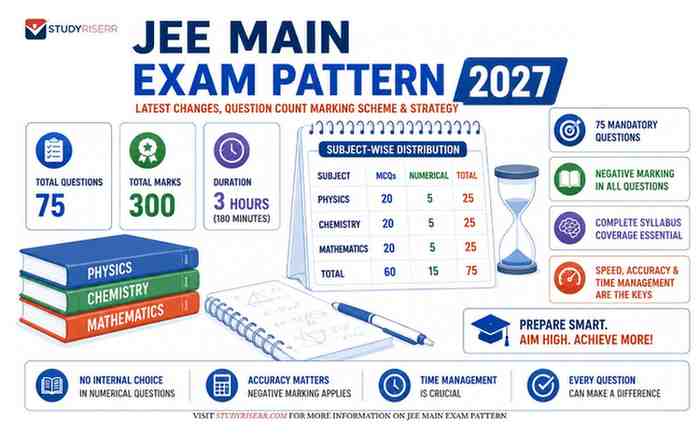
Read: JEE Main 2026 Paper Pattern, Marking Scheme, & Ques-pattern
JEE Main Preparation Month 2: Intensive Practice & Analysis
In this phase, you will practice more, analyze your mistakes and cover any remaining important topics:
Practice
- Mock Tests: Take 2-3 full-length computer-based mock tests per week with all types of question difficulty.
- Mock Test Analysis: This is the most important step that most students usually ignore. That is, after each test, spend your time analyzing your performance. Identify weak areas, conceptual errors and time-management issues. You can also maintain a "mistake notebook" to avoid repeating errors.
Previous Year Questions (PYQs): Solve chapter-wise PYQs from the last 5 years to get familiar with their standard of questions, exam pattern and question types.
Covering remaining topics
- Physics: Cover medium-weightage topics like Magnetic Effects of Current and Magnetism, Electromagnetic Induction and Waves.
- Chemistry: Address remaining chapters like Chemical and Ionic Equilibrium, Biomolecules, and practical chemistry concepts.
- Mathematics: Practice problems from Vector Algebra, Three-Dimensional Geometry and Probability.
JEE Main Preparation Month 3: Final Days-revision and Refinement
This final sprint is all about revision and building exam temperament:
Revise and Practice
- Intensive revision: Dedicate at least 70% of your study time to revision using your short notes, formula sheets and mistake notebook.
- Daily Mock Tests: In the final weeks, take one full-length mock test almost every day to build stamina and fine-tune your strategy.
- PYQ Focus: Practice solving full previous year papers.
- NCERT for Chemistry: Revise NCERT thoroughly for Inorganic and Organic Chemistry.
Check: JEE Main 2026 Subject -wise Syllabus Topics, PDF, Best Books
Daily Study Routine Guide for You
Maintain this integrity until the last day for your JEE Main 2026 preparation. Check our easy routine to divide the day into preparation hours for the upcoming exam:
- Time Allocation: Aim for 8-10 focused study hours per day. For example, 3 hours for Physics, 2.5 hours for Chemistry, and 2.5 hours for Mathematics.
- Daily Practice: Solve at least 30 MCQs daily from the topics you cover.
- NCERT First: Strengthen your basics with NCERT.
Also Read,
- JEE Main 2026: NTA Introduces Aadhaar-Based Autofill; Check Complete Details
- JEE Main 2026 Application Form (Oct), Check Dates, Eligibility & Error Correction

Related News






Confused About Your Career?
Talk to an expert at Studyriserr


.png)




.jpg)

.webp)
.webp)

