





The Indian Institute of Technology (IIT) Madras has officially released the updated syllabus for the Graduate Aptitude Test in Engineering (GATE) on gate2027.iitm.ac.in. Review the specific updates and revisions introduced across the GATE 2027 syllabus for ECE, ME, CE, EE, DA, and CSE test papers.
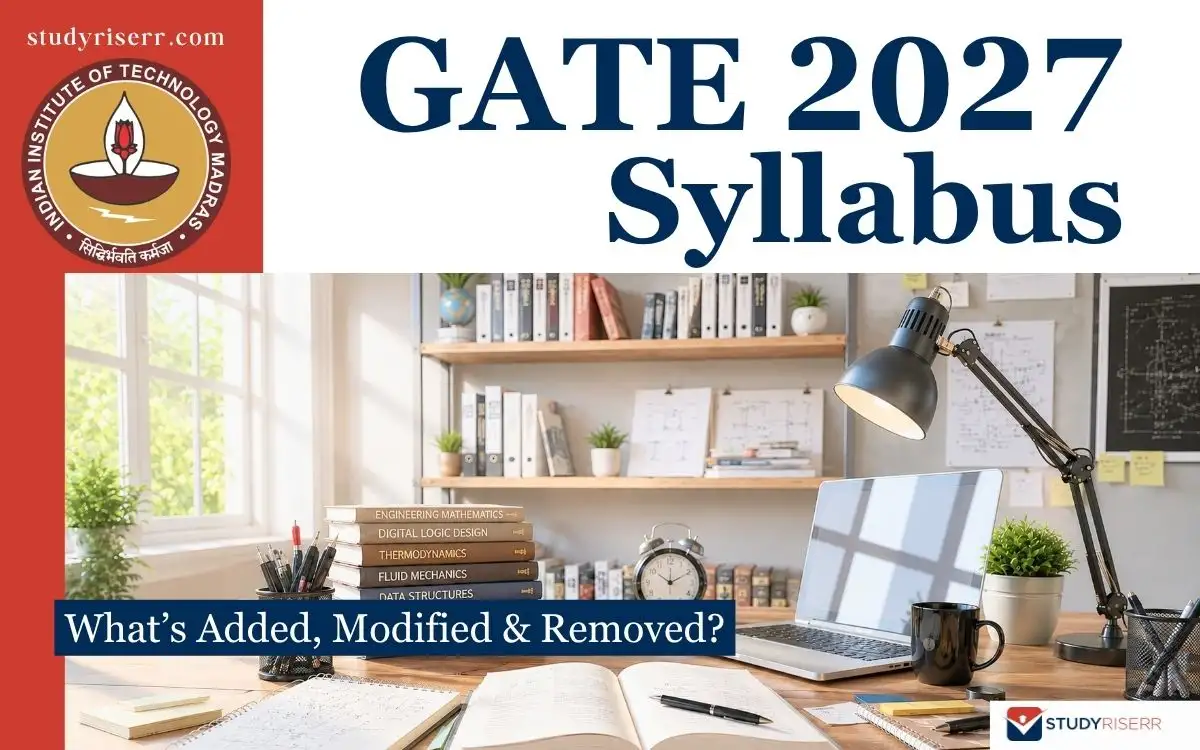
Designed to align with modern industry standards, the updated GATE syllabus marks the first major curriculum overhaul in five years. Alongside these changes, authorities have launched the official portal and introduced a new test paper for Robotics and Automation.
Aspirants across ECE, CSE, ME, and CE will encounter various conceptual additions and refined sub-topics. While several papers have undergone restructuring, streams like Electrical Engineering and Data Science remain unchanged.
Key Highlights of GATE 2027 Syllabus Updates
IIT Madras has modernized concepts across multiple branches to focus on core domain demands.
- Expanded Sectional Structure: Civil Engineering (CE) now features 8 main sections instead of 7, making Construction Materials and Management a standalone subject.
- Unchanged Papers: The syllabus for Electrical Engineering (EE) and Data Science and Artificial Intelligence (DA) remains completely unchanged from the previous edition.
Branch-Wise GATE 2027 Syllabus Analysis
Aspirants preparing for the upcoming GATE 2027 examination can review the comprehensive, branch-wise breakdown of the revised syllabus below:
1. Computer Science and Engineering (CSE)
IIT Madras has restructured and updated three primary technical subjects in the CSE paper:
- Computer Networks
- Digital Logic
- Computer Organization and Architecture
2. Electronics and Communication Engineering (ECE)
Nearly 90% of the ECE syllabus remains intact, while key concepts have been refined under specific topics.
| Subject Area | Topics Added | Topics Deleted / Modified |
| Engineering Mathematics | Correlation and regression analysis | Restructured into Linear differential equations, Euler-Cauchy equation, and Nonhomogeneous equations |
| Networks, Signals & Systems | FIR and IIR filter design; Nyquist sampling theorem | Discrete-time processing of continuous-time signals (Removed) |
| Electronic Devices & Analog | Energy bands in solids, MOSFET scaling, Dominant-pole (Miller) compensation, Phase margin | — |
| Control Systems & Comms | PID controller, Source coding, broaden lag/lead compensators | — |
| Unchanged Sections | Digital Circuits and Electromagnetics are completely unchanged. | — |
3. Civil Engineering (CE)
The syllabus has expanded from 7 to 8 sections. Construction Materials and Management, previously a sub-topic under Structural Engineering, is now an independent section (Section 8).
- Additions: Principle of virtual work, Castigliano's second theorem, sheet piles, ground improvement techniques, streamflow measurement, mobile channels, unsteady flow, weirs, river training, earthen dams, and well irrigation.
- Deletions: Sampling theorems, free vibrations of undamped SDOF systems, prestressed concrete beams, plate girders and trusses, flexibility method, and dynamic pile capacity formulae.
4. Mechanical Engineering (ME)
The Mechanical Engineering syllabus has integrated advanced control dynamics and thermal concepts:
- Additions: 2-DOF systems, damping estimation and transmissibility ratio, control systems, PID controllers, transfer functions, belt drives, Air-Fuel Ratio & Equivalence Ratio (combustion), and ASA & ORS tool geometry systems.
- Deletions: Lagrange’s equation and Heisler’s charts.
5. Electrical Engineering (EE) & Data Science / AI (DA)
Candidates preparing for Electrical Engineering (EE) or Data Science and Artificial Intelligence (DA) can continue using the previous year's curriculum, as no updates or modifications have been made to these papers.
Check: GATE 2027 Full Schedule

Related News


Confused About Your Career?
Talk to an expert at Studyriserr




.png)



.jpg)
.webp)
.webp)

